Types of Robotic Arms and Their Uses (Guide for Manufacturers)

Robotic arms are the workhorses of modern automation, moving, welding, assembling, and inspecting parts with speed and repeatability that humans can’t match. This guide breaks down the main types of robotic arms, where each excels, and how to choose the right one for your application.

A robotic arm is a motor-driven manipulator with joints and links that position an end-effector (i.e. a gripper, torch, dispenser or vision camera) to perform tasks. Industrial arms typically offer 3–7+ degrees of freedom (axes), enabling complex motion paths and high repeatability.

The 9 main types of robotic arms (and what they do best)

Articulated (6-axis) robots, the general-purpose standard

The first industrial robot (Unimate, 1961) was created to lift and stack hot die‑cast parts that were dangerous and tedious for humans. As assembly tasks grew more complex, multi‑axis electric arms were developed to follow arbitrary paths for welding, painting, and machine tending. 

  • Structure: 5–6+ rotary joints (axes), mimicking a human arm.
  • Best for: Welding (arc/spot), painting, assembly, machine tending, material handling, dispensing.
  • Why choose it: Largest work envelope and flexibility; handles complex paths and multiple orientations.
  • Watch-outs: More complex programming; may need fencing unless using a cobot variant.
Articulated (6-axis) robot

Six-axis robots (subset of articulated)

Building on the Unimate’s legacy, six‑axis designs became the standard for flexible, repeatable motion across welding, palletizing, and CNC tending. They were optimized to balance reach, dexterity, and payload for most mid‑to‑high complexity tasks. 

  • Structure: Exactly six rotary axes; the most common industrial robot.
  • Best for: Almost any mid-to-high complexity task, welding cells, palletizing, CNC tending, inspection.
  • Why choose it: Best balance of reach, dexterity, and payload options (from ~3 kg to 800+ kg).
  • Watch-outs: Total cost is often 2–4× the arm price once you add tooling, safety, and integration.
Six-axis robot

Collaborative robots

While industrial arms delivered speed and payload, they required fencing and strict separation from people. Cobots were introduced to enable safe, close human–robot collaboration using force‑limiting joints and advanced sensing for light assembly, machine tending, and dispensing. 

  • Structure: Typically 6-axis, with force/torque sensing and safety features for near-human work.
  • Best for: Light assembly, screw fastening, machine tending, dispensing, packaging, quality checks.
  • Why choose it: Faster deployment, easier programming, reduced guarding (risk-assessed), good for SMEs.
  • Watch-outs: Lower payload/speed vs. industrial arms; still requires risk assessment and often light guarding.
Collaborative robot

SCARA robots (Selective Compliance Assembly Robot Arm)

In the late 1970s, general‑purpose arms were too slow and stiff for high‑speed electronics assembly. Professor Hiroshi Makino created SCARA (1978; commercialized 1981) to be compliant horizontally but rigid vertically, enabling fast, precise pick‑and‑place of small components. 
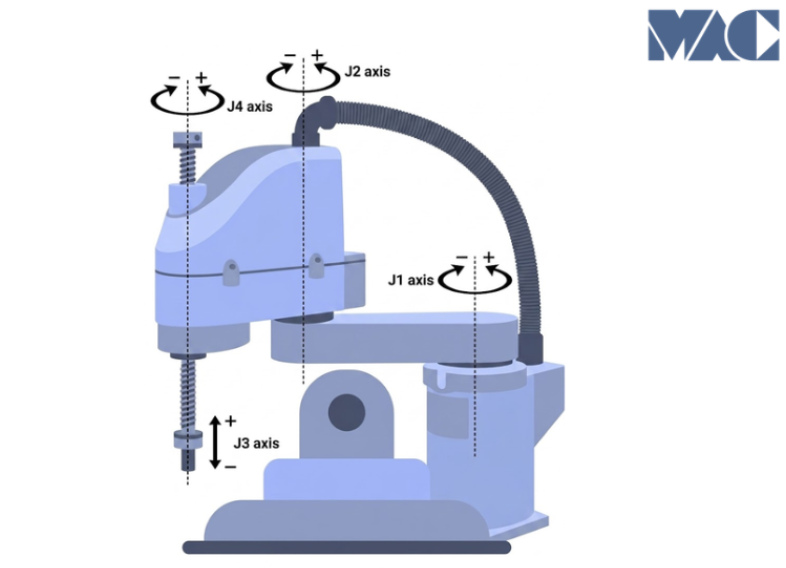
  • Structure: Two parallel rotary joints for fast, precise motion in a horizontal plane.
  • Best for: High-speed pick-and-place, electronics assembly, dispensing, small-part handling.
  • Why choose it: Exceptional speed and repeatability in-plane; compact footprint.
  • Watch-outs: Limited vertical/Z-axis flexibility; not ideal for complex 3D paths.

Cartesian / Gantry robots

As CNC machining and structured assembly matured, manufacturers needed simple, rigid, highly accurate linear motion over large work envelopes. Cartesian/gantry systems (X‑Y‑Z linear axes) became popular for machine loading, precise insertion, and large‑area pick‑and‑place where tasks are rectilinear and repeatable. 
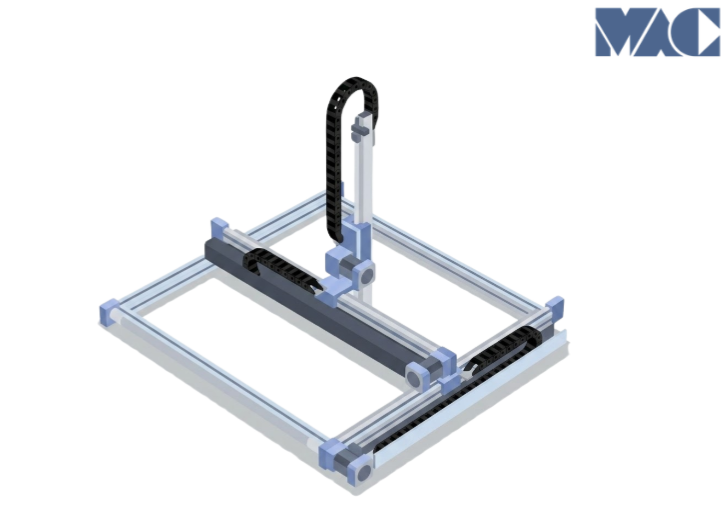
  • Structure: Three linear axes (X, Y, Z) forming a rectangular work envelope.
  • Best for: CNC/3D printing, machine loading, precise insertion, small-to-medium assembly.
  • Why choose it: Simple, rigid, cost-effective; easy to scale with long travels.
  • Watch-outs: Less dexterous than articulated arms; best for structured, repeatable tasks.

Cylindrical robots

In 1960–1962, AMF introduced the Versatran, one of the first cylindrical robots, installed at Ford for versatile transfer tasks like machine tending and spot welding within a cylindrical work envelope. The design balanced rotation at the base with linear vertical/radial motion, fitting tightly around machines where a compact, column‑like reach was ideal.
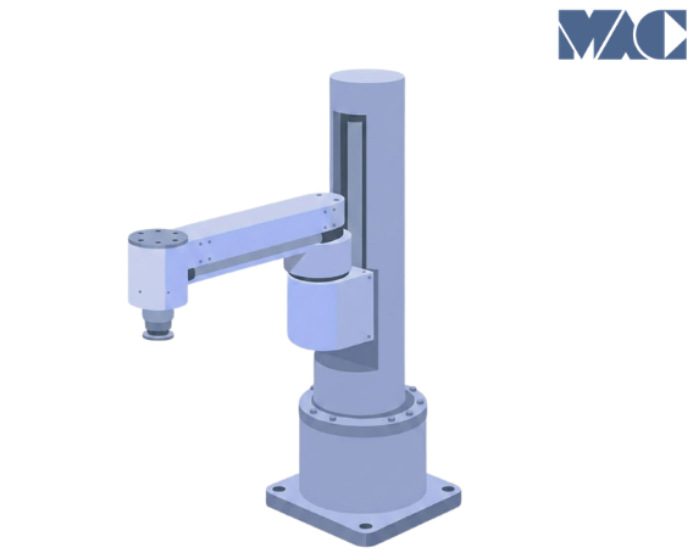
  • Structure: Vertical linear axis + horizontal rotation + radial extension.
  • Best for: Spot welding, machine tool handling, simple assembly in tight spaces.
  • Why choose it: Compact and efficient for focused workspaces.
  • Watch-outs: Limited workspace shape; less common for complex applications.
Cylindrical robots

Spherical / Polar robots

Among the earliest industrial forms, spherical/polar robots (two rotary joints + one linear) offered a spherical work envelope suited to die casting, injection molding, welding, and material handling in the 1960s–1970s. They were innovated to handle hot, heavy parts and perform simple, repetitive arcs where a polar coordinate motion matched the cell layout. 

  • Structure: Rotary base + shoulder + radial arm (polar coordinate system).
  • Best for: Die casting, injection molding, welding, material handling (legacy but still used).
  • Why choose it: Simple design with a spherical work envelope.
  • Watch-outs: Less prevalent today; articulated arms often replace them for flexibility.

Parallel / Delta robots

In the early 1980s, a Swiss team led by Reymond Clavel at EPFL visited a chocolate factory and realized there was no robot that could pack light pralines at very high speed with high repeatability. They invented the Delta robot (patented 1985; commercialized late 1980s) with a parallel linkage design to achieve extreme acceleration for light, high‑throughput pick‑and‑place in packaging and food/pharma. 
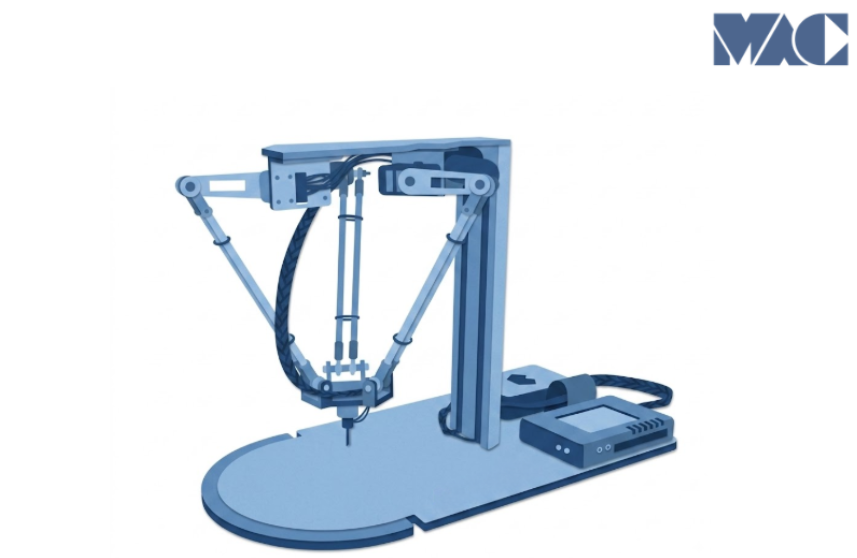
  • Structure: Three arms connected to a common base, moving a lightweight platform.
  • Best for: Ultra-high-speed pick-and-place, packaging, sorting (food, pharma, electronics).
  • Why choose it: Unmatched acceleration and throughput for light payloads.
  • Watch-outs: Limited payload and reach; best for overhead mounting and light items.

Anthropomorphic / Dual-arm robots

Inspired by human biomechanics and early research arms like PUMA, anthropomorphic and dual‑arm systems were developed to replicate human‑like dexterity for complex assembly, research, and collaborative tasks. These remain more specialized, often appearing in labs, advanced assembly, and emerging mobile manipulator platforms. 

  • Structure: Human-like arms (often dual) with advanced dexterity; sometimes mobile bases.
  • Best for: Collaborative tasks, complex assembly, research, specialized handling.
  • Why choose it: Human-mimicking motion for intricate tasks and close human interaction.
  • Watch-outs: Rare in mainstream industry; higher cost and complexity.

Industries and applications: where robotic arms deliver ROI

  • Automotive: Arc/spot welding, paint booths, sealant dispensing, large-part handling, palletizing.
  • Electronics: SCARA and delta for PCB assembly, micro-dispensing, high-speed pick-and-place.
  • Food & Beverage/Pharma: Delta and 6-axis for packaging, sorting, case packing, hygienic cells.
  • Metalworking/Machining: 6-axis for CNC tending, deburring, grinding, machine loading.
  • Logistics/Warehousing: Palletizing cells, gantry pickers, mixed-SKU picking with vision.

When to use (and not use) robotic arms

Use robotic arms when:

  • Tasks are repetitive, hazardous, or ergonomically risky.
  • You need consistent quality, traceability, and higher throughput.
  • Labor is scarce or costly, and you can standardize the workflow.


Avoid or rethink when:

    • Parts vary wildly without reliable vision/fixturing (unless using advanced AI grasping).
    • Cycle times are extremely short and manual is still faster (for very low volumes).
    • You can’t commit to integration, maintenance, and change.

Cost and ROI: what to budget in 2026

    • Arm-only pricing:
      • Cobots (3–18 kg): $20,000–$50,000
      • 6-axis industrial (light 6–20 kg): $25,000–$55,000
      • 6-axis industrial (heavy 50–800 kg): $50,000–$120,000
      • SCARA (3–20 kg): $15,000–$40,000
      • Delta (8–15 kg): $30,000–$60,000
    • Full cell costs (arm + EOAT + safety + integration + commissioning): often 2–4× the arm price; typical installed systems land at $50,000–$250,000+ depending on complexity.
    • Payback periods: commonly 12–24 months for well-scoped projects; simple cobot cells can hit 6–12 months; complex custom cells may take 18–36 months.

    Simple payback formula:

    Payback (years)=Total project costAnnual net savings\text{Payback (years)} = \frac{\text{Total project cost}}{\text{Annual net savings}}Payback (years)=Annual net savingsTotal project cost​

    where annual net savings = labor displaced + scrap/rework reduction + throughput gains − (energy + maintenance + consumables)

How to choose the right robotic arm (quick selection checklist)

  • Task type: welding, painting, assembly, pick-and-place, machine tending, inspection.
  • Payload and reach: match part weight and workspace size to robot
  • Speed vs. accuracy: delta/SCARA for speed; 6-axis for flexibility; Cartesian for precision.
  • Environment: cleanroom, washdown, hazardous areas, temperature extremes.
  • Integration: end-of-arm tooling, vision, safety systems, PLC/robot controller, data logging.
  • Total cost of ownership: include installation, training, maintenance, spare parts, and changeovers.

Next steps

If you’re evaluating automation, start with one repeatable task, define success criteria, and instrument logs from day one. For help sizing cells, estimating ROI, or designing a weld/palletizing/tending solution, request a consultation.

Contents